UPSC Mains Answer Practice GS Paper 1 (Week 130): Preparing for UPSC Civil Services Exam 2026? Here is this week’s UPSC Mains GS-1 answer-writing practice, designed to strengthen your conceptual clarity and help you master analytical writing for the Mains examination.
This week’s set includes two high-value topics:
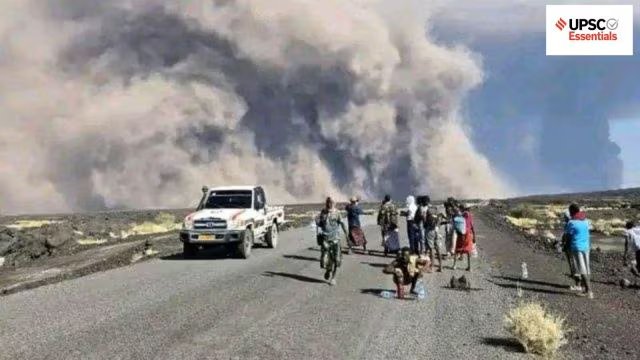
Geological factors behind effusive vs. explosive volcanic eruptions, with reference to the Hayli Gubbi eruption in Ethiopia.
Why tropical forests are considered biodiversity hotspots and the major threats they face today.
These questions align with the UPSC CSE Mains syllabus under GS Paper-1 (Geography & Environment).
QUESTION 1
What are the geological factors that determine whether a volcanic eruption will be effusive or explosive? Discuss in the context of Hayli Gubbi’s recent eruption.
Introduction (3–5 lines)
The Hayli Gubbi volcano in northeastern Ethiopia erupted recently after nearly 12,000 years of dormancy. Interestingly, instead of fluid lava flows, the volcano produced large plumes of ash and gases, indicating an explosive character. Whether a volcanic eruption becomes effusive or explosive is governed by key geological parameters such as magma viscosity, gas content, silica composition, and rate of magma ascent.
Body
Factors determining the nature of volcanic eruptions
1. Magma Composition and Silica Content
- High silica magma (rhyolitic/andesitic) → high viscosity → traps gases → explosive eruptions.
- Low silica magma (basaltic) → low viscosity → gases escape easily → effusive lava flows (e.g., Hawaiian volcanoes).
2. Magma Viscosity
- High viscosity prevents gas escape → pressure builds → explosive release of ash, tephra, and pyroclasts.
- Low viscosity allows smooth lava flow → gentle effusive eruptions.
3. Gas Content and Volatile Pressure
- High dissolved gases (water vapour, CO₂, SO₂) → violent expansion → explosive blast when pressure is released.
- Low volatile content → insufficient pressure for explosive fragmentation.
4. Rate of Magma Ascent
- Rapid ascent traps gases → abrupt decompression → explosive eruption.
- Slow ascent allows degassing → leads to effusive lava outpouring.
Hayli Gubbi Eruption: Application of Concepts
- The recent Hayli Gubbi eruption displayed ash-dominated, explosive behaviour, indicating high gas concentration and silica-rich viscous magma.
- Thick ash plumes disrupted aviation routes and spread across Ethiopia, Yemen, Oman, Pakistan, India, and even parts of China due to strong easterly winds.
- The eruption highlights how volatile-rich magma combined with rapid gas release can shift even a dormant volcano toward explosive activity.
Conclusion
Ethiopia is home to 58 known volcanoes (NOAA data), many located along tectonically active zones of the East African Rift. Understanding the geological determinants of eruption styles is vital for hazard preparedness and minimizing risks to aviation, settlements, and regional ecosystems.
QUESTION 2
“Tropical forests are the engines of global biodiversity and climate regulation.” Discuss the factors responsible for their high biodiversity and the threats they currently face.
Introduction (3–5 lines)
Tropical forests, covering less than 10% of the Earth’s land surface, account for over 50% of global biodiversity and play a critical role in climate regulation, carbon sequestration, and hydrological cycles. Their ecological richness is shaped by unique climatic and evolutionary factors, but today these forests face mounting anthropogenic threats.
Bod
Factors Behind High Biodiversity in Tropical Forests
1. Warm and Stable Climate
- Year-round warm temperatures and abundant rainfall support continuous plant growth, creating diverse habitats.
2. High Primary Productivity
- Fast nutrient cycling and intense sunlight lead to high biomass, enabling complex food webs and species diversification.
3. Structural Complexity
- Multiple canopy layers (emergent, canopy, understory, forest floor) create specialized ecological niches.
4. Evolutionary Time and Stability
- Long-term climatic stability allowed uninterrupted evolution, speciation, and reduced extinction rates.
5. Mutualistic Interactions
- Pollinators, seed dispersers, and symbiotic organisms contribute to coevolution and species diversification.
Current Threats to Tropical Forests
1. Deforestation and Land Use Change
- Conversion into farmland, cattle ranches, and plantations (e.g., palm oil, soy) is the largest driver of forest loss.
2. Climate Change
- Altered rainfall patterns, increased temperatures, and extreme weather disturb forest resilience.
3. Illegal Logging and Resource Extraction
- Timber smuggling, mining, and fuelwood harvesting degrade forest ecosystems.
4. Biodiversity Loss
- Habitat fragmentation disrupts ecological corridors and weakens populations of endemic species.
5. Forest Fires
- More frequent and intense fires—both natural and human-induced—accelerate degradation.
Conclusion
Tropical forests remain indispensable for maintaining global biodiversity and regulating climate systems. Strengthening conservation strategies, promoting community-based forest management, and integrating climate-resilient policies are essential for safeguarding these ecological treasures.