
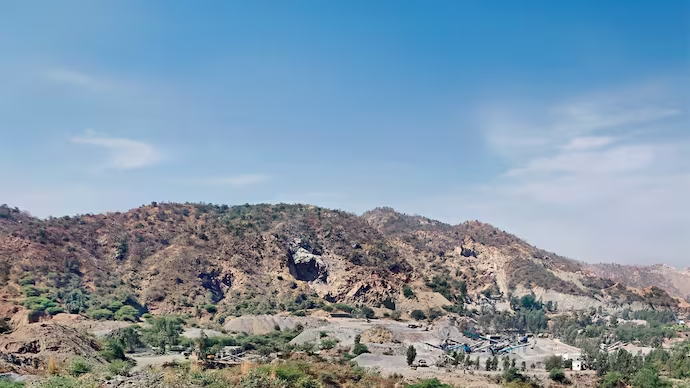
Aravalli Hills Controversy: A controversy over the new definition of the Aravalli Hills has triggered widespread concern among environmental activists, scientists, and citizens. At the centre of the debate is Environment Minister Bhupender Yadav, who has faced intense scrutiny following allegations that the revised definition could open large parts of the Aravalli range to mining and construction.
The issue arose after the Supreme Court accepted a government-proposed definition that classifies only landforms rising 100 metres above local relief as Aravalli hills. Under this framework, two or more such hills within 500 metres, along with the land between them, would qualify as an Aravalli range. The ancient mountain system stretches across Rajasthan, Gujarat, Haryana and Delhi, and plays a critical role in preventing desertification and protecting Delhi’s air quality.
Key Allegations and Government Response
Claim 1: 90% of the Aravallis will lose protection
Activists allege the new definition could exclude nearly 90% of the hills, enabling mining and real estate development.
- Government response: The minister gave differing figures, first claiming only 0.19% of the Aravallis were eligible for mining, and later stating the figure was close to 2%.
- Assessment: Inconsistent. Official data from earlier surveys suggests only a small percentage of hills exceed the 100-metre threshold.
Claim 2: Lower hills crucial to ecology will be unprotected
Environmental groups argue that smaller hills, though lower in height, are vital for groundwater recharge and local livelihoods.
- Government response: The Centre said around 90% of the area remains protected, and no new mining leases will be allowed within Aravalli hills or ranges.
- Assessment: Largely reassuring, but final clarity depends on the proposed sustainable mining management plan.
Claim 3: Ambiguity around the 100-metre rule
Critics fear the definition ignores ecologically connected ridges and landforms.
- Government response: The minister clarified that protection applies to the entire landform — including the base and slopes — not just the peak.
- Assessment: Partially clear. Protection of adjacent ridges and intervening landscapes remains uncertain.
Claim 4: Illegal mining will continue unchecked
Activists warn that excluded areas could become hotspots for illegal mining.
- Government response: The Centre acknowledged illegal mining as a major threat and promised improved surveillance using drones.
- Assessment: Unclear. No concrete steps were outlined to address long-standing enforcement failures.
The Bigger Picture
The Aravalli Hills are among the world’s oldest mountain ranges and act as a natural barrier against desertification while serving as Delhi’s ecological shield. Given their environmental significance, clarity on what constitutes the Aravalli range is crucial.
Verdict
While the government has attempted to clarify the revised definition, conflicting statements, partial explanations and unanswered questions have fuelled public distrust. As it stands, the controversy reflects a mix of answers, half-answers and non-answers, with the final impact of the new definition still open to interpretation.





I was amazed at how every viewpoint in the Black Forest offers a completely different perspective. You never run out of beautiful landscapes to admire.
Castle Hill is perfect for both adventure and photography. The rocks create natural frames for every shot, making every photo look epic.